Wasting Safety
Community Culture
Exhibition Design • Photography • Graphic • Product Design • Research
The exhibition, both virtual and physical, born from the group's need to disseminate and raise awareness on the theme of conscious, measured and de-westernised design. Wasting Safety, born from the thesis project (Bachelor's Degree in Product Design) of Andrea Pradella, co-founder of Plam Studio, has been transformed in 2020 by the design group into a virtual and physical educational exhibition.
Ferrara • 2020
CLIENT
Laboratorio Aperto Ferrara
PUBLICATIONS
dezeen, Filo Mag
USEFUL LINKS
WS virtual exhibition
PARTNERSHIPS
Laboratorio Aperto Ferrara, Dipartimento Architettura Ferrara, NID National Istitute of Design India, Paryavaran Mitra
PATRONAGE
CGIL Ferrara, Comune di Ferrara, Provincia di Ferrara


Wasting Safety
The exhibition, which was inaugurated virtually on 25 April 2020 through the creation of a dedicated website, was later self-produced and held from 25 to 27 June 2021 at the Laboratorio Aperto di Ferrara, Ex Teatro Verdi, with the support of the Municipality of Ferrara, the Province of Ferrara, the Emilia-Romagna Region, CGIL Ferrara and the University of Ferrara, and in partnership with NID - National Institute of Design, India and Paryavaran Mitra.
The exhibition was born from the need to raise awareness and disseminate the concept of conscious, measured and "de-westernised" design. It's no coincidence that the exhibition structure narrates the context, the data collected and the entire design process, from A to Z, of a field study conducted as a designer in one of India's largest metropolises, characterised by particular social and cultural needs.
Wasting Safety, literally 'wasting safety', immediately introduces the issues it seeks to highlight through a play on words. The main theme is the worker, with a focus on his safety and protection during work activities. Particular emphasis is placed on the often overlooked issue of Personal Protective Equipment (PPE).
PPE sold in Europe must carry a mark certifying compliance with essential health and safety requirements. However, aesthetics and social impact are not always considered, and when they are, the Western model dominates.
But what if, in addition to the health and safety parameters that apply to everyone, the socio-cultural variable of the geographical location where the PPE is to be used were also taken into account?
The protective equipment currently in use is designed on the basis of standardised contexts but does not take into account the traditions, customs and values of cultures other than Western ones. Consequently, some equipment may not be suited to the actual needs of the workers using it. To explore new aspects of human behaviour at work, we have chosen to analyse a complex and little-known occupation within an extraordinary cultural context: Indian women employed in waste collection and sorting (waste-collectors). These women, feeling ashamed of their work in close contact with rubbish, in some cases choose not to wear equipment that might draw attention to their status.
As designers, our contribution is to propose an inclusive approach from a social and cultural perspective. During the exhibition, visitors can view various prototypes, studio photographs, diagrams and design drawings.
Through its analysis of an extreme scenario, WS aims to stimulate reflection and dialogue on working environments that are much closer to our own reality, and on the genuine safety, social and cultural needs of people at work.
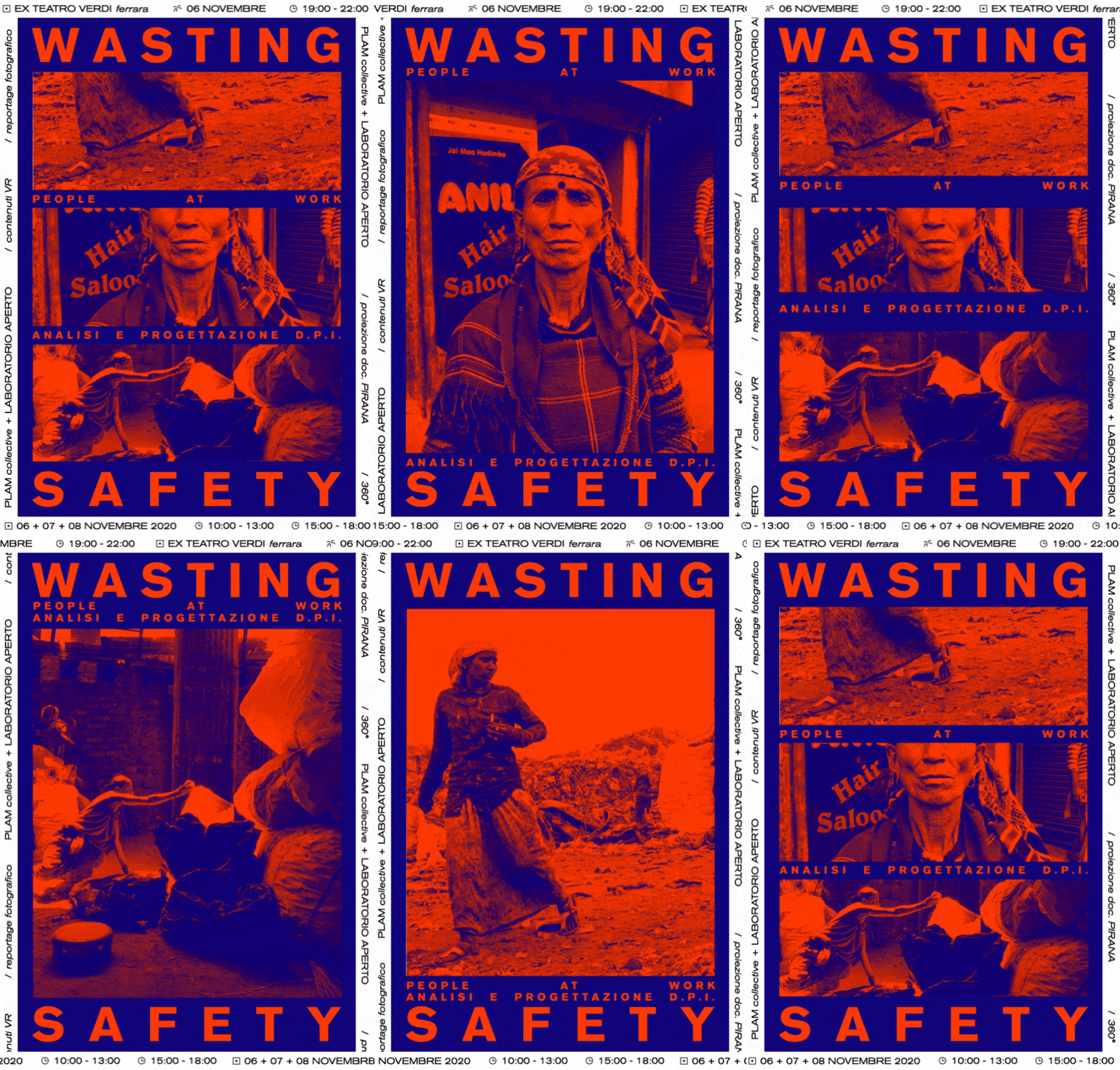
From a virtual exhibition to a physical one
During the months of the Covid-19 pandemic, whilst the ‘lockdown’ was in full force, Plam created a website and a virtual tour of the exhibition, enabling remote access to the exhibited content. The entire visual, graphic and experiential elements were developed, in collaboration with a sound designer for the audio environment.
( https://wastingsafety.altervista.org/ )
The physical exhibition was hosted in the Scenic Tower of the former Teatro Verdi in Ferrara, a spacious hall adjacent to the stalls. At the centre, a stylised model of the city of Ahmedabad provided context for the project. The other display cases contained samples of materials collected during the design phase, design sketches, models and prototypes. In the background, photographs taken during the months of research were arranged as a large mood board on the wall, enriched with notes, reflections and QR codes providing further thematic insights.
One area of the hall had been set up with two VR stations, where visitors could immerse themselves in a virtual rubbish tip.
In the adjoining room, there will be a screening of the documentary *Pyrana*, which explores the daily working life at the largest open-air rubbish tip in the city of Ahmedabad, directed by Nainisha Dedhia.